% against the same load without storage18.6%
Week on week+1.4 ppHigher
2077-06-23 – 2077-09-08
- Selected range change
- +5.8 ppHigher
- Range low
- 12.8
- Range high
- 18.6
Data table & CSV download 12 weekly observations
Download CSV| Recorded | Value (%) | Previous week |
|---|---|---|
| 2077-09-08 | 18.6 | +1.4 ppHigher |
| 2077-09-01 | 17.2 | +0.4 ppHigher |
| 2077-08-25 | 16.8 | +0.4 ppHigher |
| 2077-08-18 | 16.4 | +0.9 ppHigher |
| 2077-08-11 | 15.5 | -0.5 ppLower |
| 2077-08-04 | 16 | +1.2 ppHigher |
| 2077-07-28 | 14.8 | -0.4 ppLower |
| 2077-07-21 | 15.2 | +0.6 ppHigher |
| 2077-07-14 | 14.6 | +1.7 ppHigher |
| 2077-07-07 | 12.9 | -0.5 ppLower |
| 2077-06-30 | 13.4 | +0.6 ppHigher |
| 2077-06-23 | 12.8 | No earlier record |
What changed this week
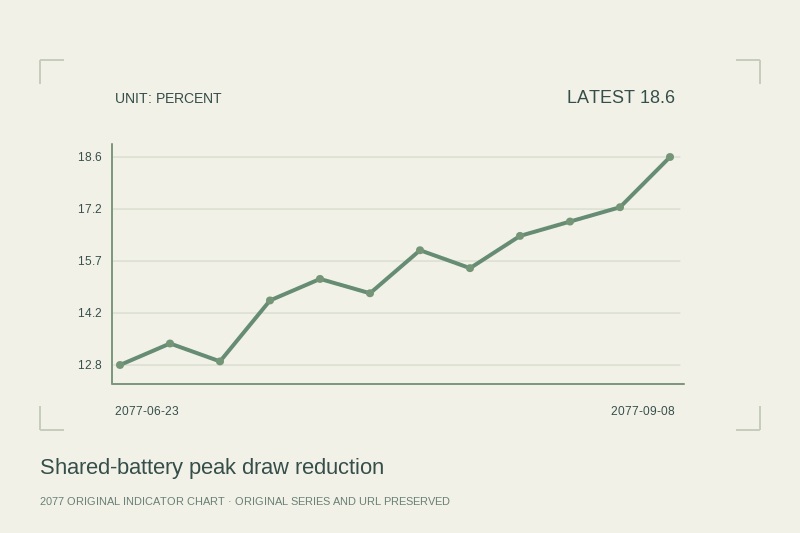
Agents aggregate household charging reservations, while a resident can prioritise a personal battery before departure. Compare evenings of shared charging with those prioritising a personal departure to read resident choice beside peak reduction.
Some buildings kept an emergency reserve; the entire battery capacity is not counted as avoided purchases.
How to read this number
Residents need to distinguish peak reduction from lower total consumption. Building managers can assess operating savings separately using charging-time tariffs and maintenance costs.