What to know
- Repeating dust layers identified 18 m down
- Deposit size and purification costs remain uncertain
- Current findings do not establish life
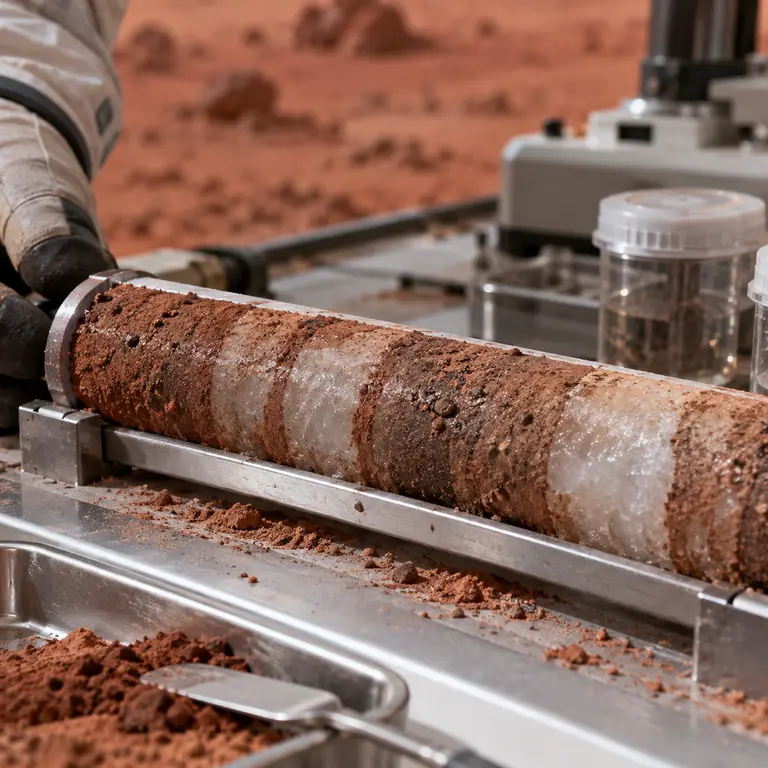
A survey east of Olympus identified repeating dust layers in an ice core taken 18 metres below the surface. Some spacing matches previously observed seasonal variation, suggesting the ice accumulated over several periods rather than freezing all at once.
The finding does not immediately expand drinking-water production. Salts and fine mineral particles could make purification costly, and more drilling is needed to establish whether the sample represents a larger deposit.
The team sent control samples from equipment surfaces and empty containers to Earth laboratories, to distinguish local material from contamination. The published findings contain no observation establishing microorganisms or biological activity.
Geologists see value in a record of recent Martian climate as well as resource estimates. Settlement water managers want research and production drilling scheduled separately so that they do not compete for the same equipment.
The next survey will compare two sites two kilometres from the original core. Continuous layers would be added to a public geological map. Coordinates and analytical procedures will be released as each dataset completes review.
Reception and data times · In transit
Fixed 2077 scenario clock · not a live data feed.
- Observed at
- Olympus Long-Stay Research Habitat · 2077-09-08 15:30:00 UTC
- Received at residence
- 2077-09-08 15:42:42 UTC
- Cache age
- —
- Next sync
- 2077-09-08 15:47:42 UTC
New people, their quotations and biographies are created for this world. This original fictional article explores institutions and life in 2077. Announcements, figures and events belong to the scenario. Reporting distinguishes established details within the story, the parties’ positions and unresolved questions.