The robot that stopped a metre short of dinner
Six Koto households kept a log of the evening tray run. Moving one partition could change who carried dinner the last metre.
8 September 2077 · Scenario fiction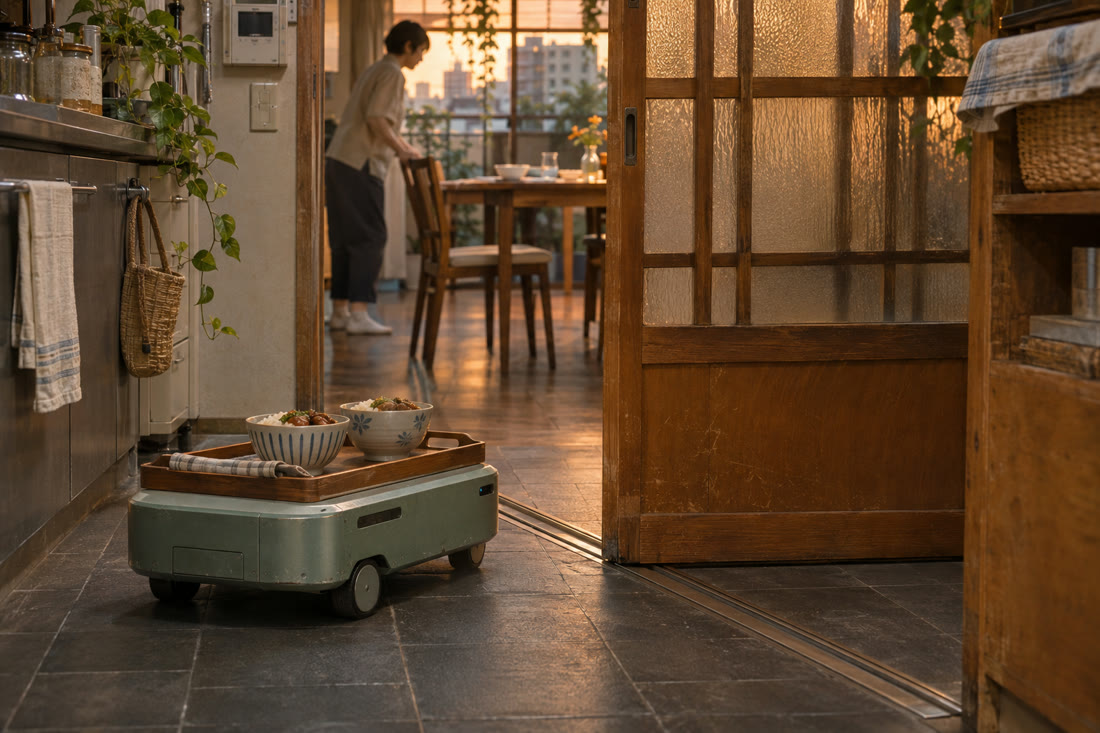
Field notes
At dinner Naoko Mori slides a partition out a little so her flatmate can finish a call. That evening she could smell the soup from her chair. The bowls never came. The household cart played its familiar chime and waited at the corner. Its display had no part to replace. It said it could not see the other side.
Mori turned sideways, slipped through the gap and carried the tray back. When service technician Aya Endo saw the spot the next day, she asked if she could come back at dinner. In daylight the partition was tucked into the wall.
A corner that only exists at dinner
“No route” was turning up on tickets at Machi Service Cooperative. It gave the desk little to go on when booking a visit. Mori’s clue was what the household was doing when the cart stopped. As soon as her flatmate finished the call, the wall slid back. The fault was gone by the next day’s inspection.
Six households with similar tickets agreed to log one dinner tray a night for four nights. They recorded whether the cart reached the table, someone at home collected the tray, or a technician had to visit. Addresses and room photographs stayed out of the pooled log.
Empty floor can still be too tight for a turn
Endo set an empty tray on the cart with the partition in its usual evening position. There was room to roll straight towards the kitchen. In the turn, though, the outside corner of the tray swept wider than the wheels. The daytime route now ran through the panel.
With the lights unchanged, folding the panel back a little exposed a turn the cart could take on a fresh local reading. Put the chair back at the corner and it stopped even with a fresh reading. On the first run the cart lacked a known turn. On the last there was no turn to take. Both stops sounded exactly alike.
A call that does not open the room to view
Dispatcher Jun Abe remembered the calls that ended with “try again.” A second stop put the resident back at the beginning of the story. Abe proposed asking once for permission to reread just the floor near the stop. With permission, the cart did the calculation at home. The desk received a pass or a hold, with no view of the room.
For Mori, allowing a check tonight was a different matter from promising to keep the same layout tomorrow. Permission expired with that tray. If someone declined, or the new reading found no turn, the desk offered a collection point or a visit. The cart stayed put while it waited for an answer.
Four fewer call-outs and a longer evening at the desk
Across the second four nights, technicians rang one doorbell, down from five. That last household chose a visit over giving repeated directions by phone. Endo’s sheet recorded a time agreed with the resident. The cooperative kept the visit option in its proposal for the following month.
Abe’s call log moved in the other direction. Getting permission, waiting on the line and agreeing on a collection point took an extra 24 desk minutes in total. Residents still collected four trays in each period. Mori’s question for the next meeting was how long the wait had been on those four occasions.
At the table, who actually took the tray?
When Mori got back from work, the tray was on the table and the cart showed a completed delivery. Her flatmate had actually got up during an evening call to carry it the last step. They asked for a space on the next log to say where a person took over. A household that saved time could then say whose time it used. Neither a contact list nor a floor plan would answer that question.
One kitchen, three decisions
Who carries supper from the hall to the small kitchen table? Like the chair in the case, a folding screen takes up turning space. The room and table stay fixed here. Only the reach of the screen changes.
The resident takes the tray the rest of the way to the table.
There is room around the screen, but the cart has no permission to check that route. The resident walks to the stop to collect the tray.
- Human work
- The resident walks the last stretch. The desk receives the collection record.
- Data trail
- The receipt records collection. The room layout stays at home.
Dinner runs in the same six homes
Anonymised synthetic records for the 2077 scenario. Six homes logged one evening run each on four nights, giving 24 runs on 24–27 August and another 24 on 3–6 September. The first three rows give the final handoff for each tray. Desk minutes are counted separately.
| Observation | Before | After |
|---|---|---|
| Cart reached the table | 15 runs | 19 runs |
| Resident collected en route | 4 runs | 4 runs |
| Technician visited for handoff | 5 runs | 1 runs |
| Total staff time on calls | 18 min | 42 min |
The periods cover the same number of trays. Four more made it to the table by cart, with four fewer technician visits. Desk calls grew from 18 to 42 minutes. Working out the net labour would also require travel time and time contributed by residents.
How much staff time would one fewer visit have to save?
From the dispatcher’s rota, each avoided visit would need to free up 6 technician minutes on average to offset the extra time on calls. This counts a technician minute and a desk minute equally. Neither travel time nor household waiting time was logged.
These households had already reported stops. Room layouts and residents’ schedules could change between the two periods. The log cannot tell us whether waiting times fell or whether households that seldom call would see the same change.
Choices for the next evening
- What if every stop triggered a new map of the home?
- A home with an obsolete route might get moving again. The chair that takes away the turning space still occupies the same place on a new map. Mori would not agree to have her flatmate’s room reread to get one dinner to the table.
- What if the first stop always booked a visit?
- A resident could simply agree to a time at the door. Another household might wait until the next visit for a problem it could settle that evening. Abe kept timed visits available for people who find describing their homes over the phone tiring.
- What disappears when a collection is counted as a completed run?
- Count only whether dinner got there and the four trays carried by residents look like any other success. At the residents’ meeting, the suggestion for the next log was to pair waiting time with the name of the role that carried the final stretch.
The next meeting will also invite households that muted the chime and began carrying their own trays. Without the homes that stopped calling, how could anyone tell fewer faults from fewer people asking for help?
Other perspectives
Engineering and fiction
These public engineering references informed the cart’s navigation. The Koto residents, cooperative logs and household consent procedure were devised for this 2077 case.
- Nav2 · Mapping and Localization
A navigation system can keep its stored map and newly sensed obstacles in separate layers. Yesterday’s trip to the kitchen tells you little about the chair someone just pulled out.
- Nav2 · Setting Up the Robot’s Footprint
Planners can check for collisions using the body’s outline on the floor. Two points may be connected on a map while the corner between them is too tight for the whole cart to turn.